Types of Sandblasting Methods
Dry sandblasting, wet sandblasting, shot blasting, ice blasting, microblasting, bead blasting, vacuum blasting, soda blasting, bristle blasting and great blasting are among them
1- Dry Sandblast
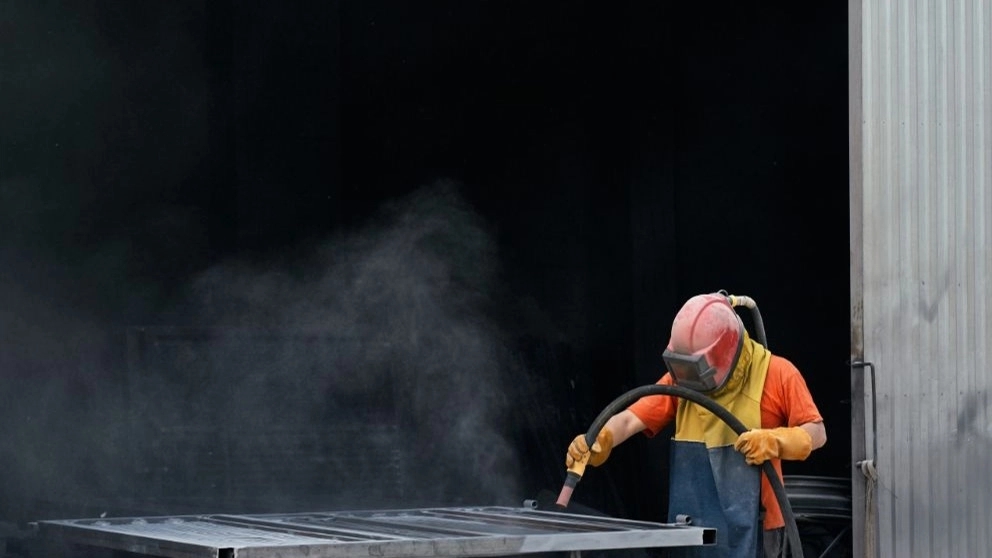
Dry sandblasting is a method in which abrasive materials are sprayed on surfaces through an air compressor at high pressure. Applications of dry sandblasting: 1. Removal of paint and rust layers and general peeling and removal of contamination from metal surfaces 2. Returning the metal surface to its original level to apply coating and paint on it 3. In order to clean the facade of buildings that have suffered a fire or are covered with crime
2- Wet Blasting (
When we use high pressure water spraying in addition to abrasive materials to remove dirt from all kinds of surfaces, we are actually doing sandblasting or wet blasting. In this method, due to the water that is sprinkled with abrasive materials on the surfaces, the dust problem that is produced in dry sandblasting is no longer there. Of course, in some cases, water is first mixed with abrasive materials, and then sprinkled on the surfaces. This method is also called dustless sandblasting. More sandblasting applications: 1. Cleaning surfaces from paint in concrete facades or iron bars using high water pressure 2. Excellent removal and cleaning of stains and unwanted materials from surfaces without creating dust 3. Creating a smooth surface without impact and scratches (in dry sandblasting, one of the goals of sandblasting is to create impact and scratches on the surfaces)
3- Shot Blasting
In the shot blast method, the desired surface pollution is cleaned and smoothed by throwing a shot. Different types of bullets are available for use in the shot blast method. Steel pellets, silicon granules are among these pellets. This method is also called centrifugal sandblasting. The biggest advantage of the shot blasting method is the use of less compressed air than other sandblasting methods. Also, in this method, a very clean and uniform surface is obtained.
4- Ice Blasting
The ice blast method or dry ice sandblasting is one of the innovative sandblasting methods. In the ice blast method, solid carbon dioxide particles (similar to snow particles) are sprayed on the desired surfaces with high pressure. Since the carbon dioxide material is non-toxic and does not react with surface contaminants, ice blasting has become a unique method for sandblasting food processing equipment. The high speed of the dry ice at the moment of contact with the surfaces and the low temperature of the dry ice break the bond between the particles of the surface and the pollution, this has made ice blasting have advantages over other sandblasting methods, which are mentioned below. we do : 1. High execution speed in ice blast method 2. Reaching a very high level of cleanliness in this method 3. No pollution of the environment in ice blasting and the compatibility of abrasive materials with the environment 4. No damage to the desired surfaces These characteristics have made ice blast very suitable for cleaning delicate surfaces such as electrical equipment and surfaces sensitive to pollution caused by other abrasives such as food processing equipment.
5- Micro Blasting
The microblast method is a small-scale sandblasting method. In this method, the nozzles are very small and the sandblasting operation is performed with high precision on the surfaces. Since in this method the nozzles are very small, it is possible to adjust the pressure to perform activities such as cutting, drilling or pleating. In some cases, microblasting is also used to change the shape of the diamond surface and to engrave on glass. The biggest advantage of microblast is its very high accuracy. For this reason, microblast is often used to clean small surfaces.
6- Bead Blasting
Glass beads are used for abrasive materials for sandblasting in the beadblasting method. Glass beads have a very high performance in cleaning surfaces. In the beadblast method, a very small (microscopic) indentation is created on the surfaces and a much more uniform surface is obtained than other methods. In addition, in this method, it is possible to collect abrasive materials, which are glass grains, and they can be used again.
7- Vacuum Blasting
In the vacuum blast or vacuum sandblasting method, abrasive materials and paint particles and surface rust are simultaneously directed to a chamber by a vacuum device, and there is no more pollution and dust. This method is the same as dry sandblasting without dust. One of the advantages of the vacuum blasting method is the collection of abrasive materials and their recycling for the next sandblasting operation. Of course, in this method, the work speed is slightly reduced, but due to the collection of abrasive materials and its recycling, it is more economical than the dry sandblasting method.
8- Soda Blasting
The soda blast method is one of the newer sandblasting methods in which baking soda particles (sodium hydrogen carbonate) are sprayed onto the desired surface by air pressure. The function of soda blast is very suitable for removing some special materials (such as house mold) from the surfaces. This method is mostly used to remove dirt from soft surfaces such as chrome, plastic or sandblasted glass. It should be noted that in the sodablast method, it is not possible to recover the used abrasive materials.
9- Bristle Blasting
In the bristle blast method, a brush with steel wires is stretched over the surface and removes the contamination. The bristle blast method is the only sandblasting method in which no abrasive material is sprayed on the surfaces. The bristle blast method is usually used for cleaning metal surfaces with high corrosion or types of wood sandblasting. Due to the direct application of the brush on the surfaces, the accuracy of polishing using this method is very high and a completely smooth and uniform surface is obtained.
10- Grath Blasting
In the grit blast method, broken pellets or grit is sprinkled on the surfaces. Grit blast is a very good method to remove color and rust from steel surfaces. Grit blast creates a smooth surface on the steel. In general, shot blasting or grit blasting increases the resistance properties of surfaces and creates a smooth and uniform surface. Thank you for staying with us until the end of this article. We will be happy to share your thoughts with us in the comment section at the end of this article.